
Bimaristan
South Africa

Reviving the Golden Age Tradition of Healing in South Africa

What are Bimaristans?
The Bimaristan was a distinctive institution of care that emerged within Islamic civilisation. The word comes from the Persian bimar, meaning “one in need of healing”, and stan, meaning “place”, literally, a place of healing.
While the great Bimaristans became renowned during the classical period of Islamic history, their foundations can be traced to principles deeply rooted in the Glorious Qur'an and the Sunnah. Care for the sick, compassion for the vulnerable, the preservation of human dignity, and service to the wider community were central values embodied by the Messenger Muhammad ﷺ and became defining features of Muslim societies. These values later found expression in organised institutions of healing known as Bimaristans.
At their heart was a holistic understanding of the human being. Healing was not limited to physical illness but recognised the interconnected nature of mind, body, heart, and soul. The mind was supported through psychological care, the body through medical treatment, the heart through emotional and relational support, and the soul through spiritual meaning and reflection, informed by the rich tradition of Ilm al Nafs, the Islamic science of the self.
Today, Fountain for Humanity draws inspiration from this legacy, adapting its principles of compassionate, holistic, and accessible care to the emotional, psychological, and humanitarian needs of contemporary communities.
Bimaristan in South Africa
While the classical Bimaristans were established in cities like Baghdad, Damascus and Cairo, the spirit of holistic and faith informed care travelled with Muslim scholars, spiritual leaders and communities across the world.
From the seventeenth century onward, Islamic traditions of healing and community service took root in South Africa and developed into contextual expressions of a deeper tradition, shaped by the diverse community. Care was understood as relational, communal and rooted in shared humanity.
In this way, the Bimaristans did not simply remain a historical memory, their ethos of integrated care and social responsibility became woven into the South African experience.
Fountain For Humanity Inspired by Bimaristans
A revived approach for holistic healing in South Africa
Fountain For Humanity draws inspiration from the Bimaristans of the Golden Age of Islam which travelled to South Africa, and as such is a living model of integrated and dignified care.
Fountain For Humanity is reviving the Bimaristans' principles within a contemporary professional framework. The services are grounded in ancient wisdom, ethical psychology and therapeutic counselling, aligned with modern standards of care, while remaining informed by faith, compassion and culturally sensitive approaches.
The fountain in the Fountain For Humanity logo symbolises life, purification, spiritual growth and compassion in motion. As the courtyards of the Bimaristans welcomed humanity, the Fountain For Humanity invites the community and humanity to an inclusive, confidential and accessible online and in-person therapeutic counselling space across South Africa.
The Wellkeepers' services are grounded in South African realities, shaped by diversity, unity, compassion, and the enduring wisdom of Ilm al Nafs.
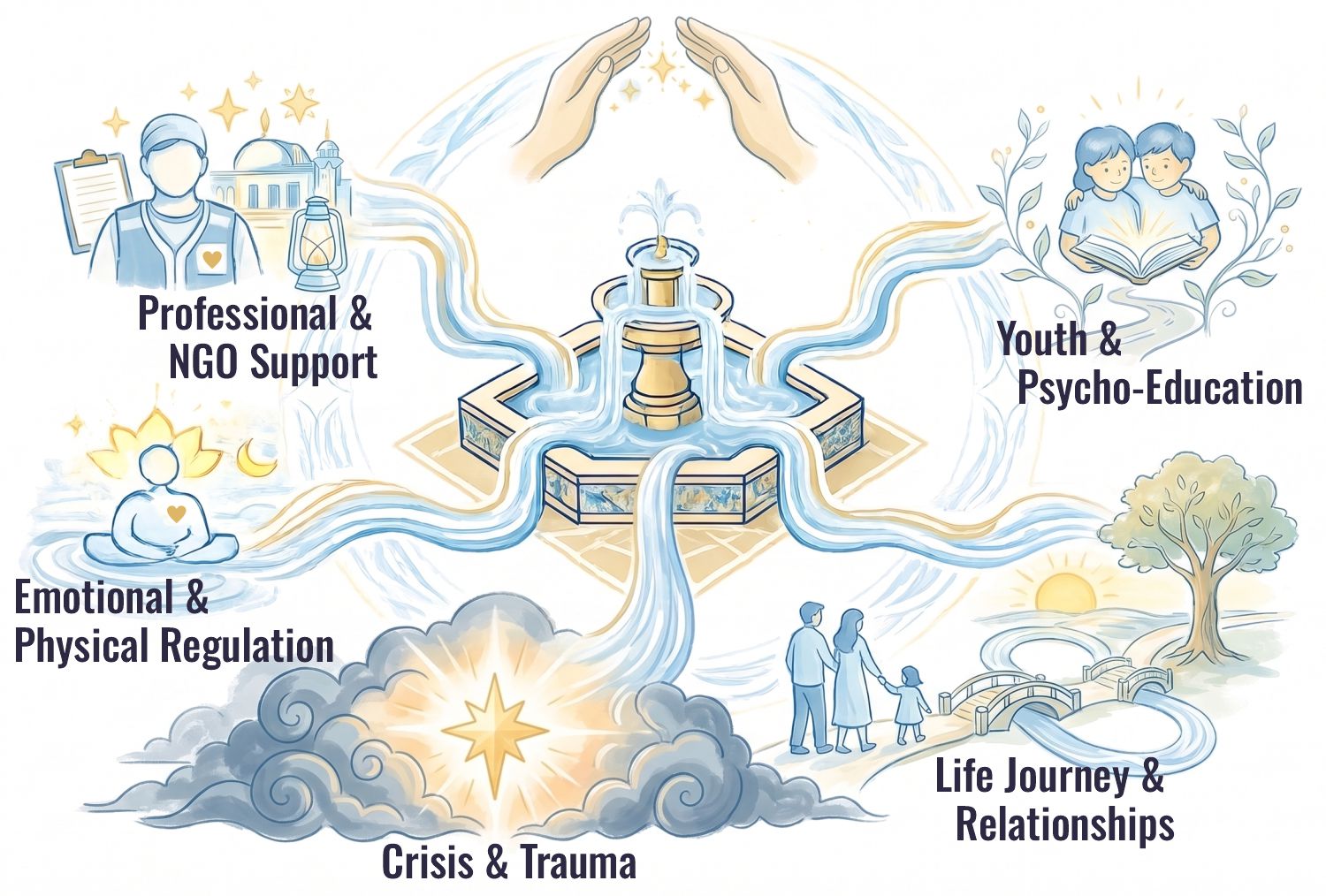
Bimaristans' Approach in Practice Through Our Services

Crisis & Trauma
Compassionate support during crisis, trauma, loss and overwhelming life events.

Youth & Psycho-Education
Supporting children, adolescence and caregivers through growth, and life challenges.

Life Journey & Relationships
Guidance through relationships, life transitions, and grief.

Emotional & Physical Regulation
Support for emotional, stress, everyday life challenges, and wellbeing.

Professional & NGO Support
Supporting those who care for others through wellbeing, resilience and reflection.